Graduation Measures
All students deserve to graduate from high school with a meaningful diploma that reflects their readiness for the future. But too many young people — disproportionately Black, Latinx, and Native American students, and students from low-income backgrounds — are graduating without the foundational skills necessary for future success. Thus, students may be required to take remedial coursework upon entering college — classes that often lead to increased debt and lower completion rates.
Graduation measures — the requirements students must meet to graduate from a New York State public high school — must prepare students for success in college and the workforce.

Our Equity-Centered Approach
As the New York State Education Department (NYSED) continues to review and rethink graduation measures through the Blue Ribbon Commission, we champion recommendations and policies that strengthen accountability measures alongside our partners from the New York Equity Coalition.
We support additional flexibility for students to demonstrate proficiency, particularly for students with disabilities and multilingual students. At the same time, we raise the alarm to ensure that school districts that under-educate students of color, particularly Black, Latinx, and Native American students, and those from low-income backgrounds, do not use graduate measures that advance students to higher education and the workforce without preparing them for success.
Latest Resource
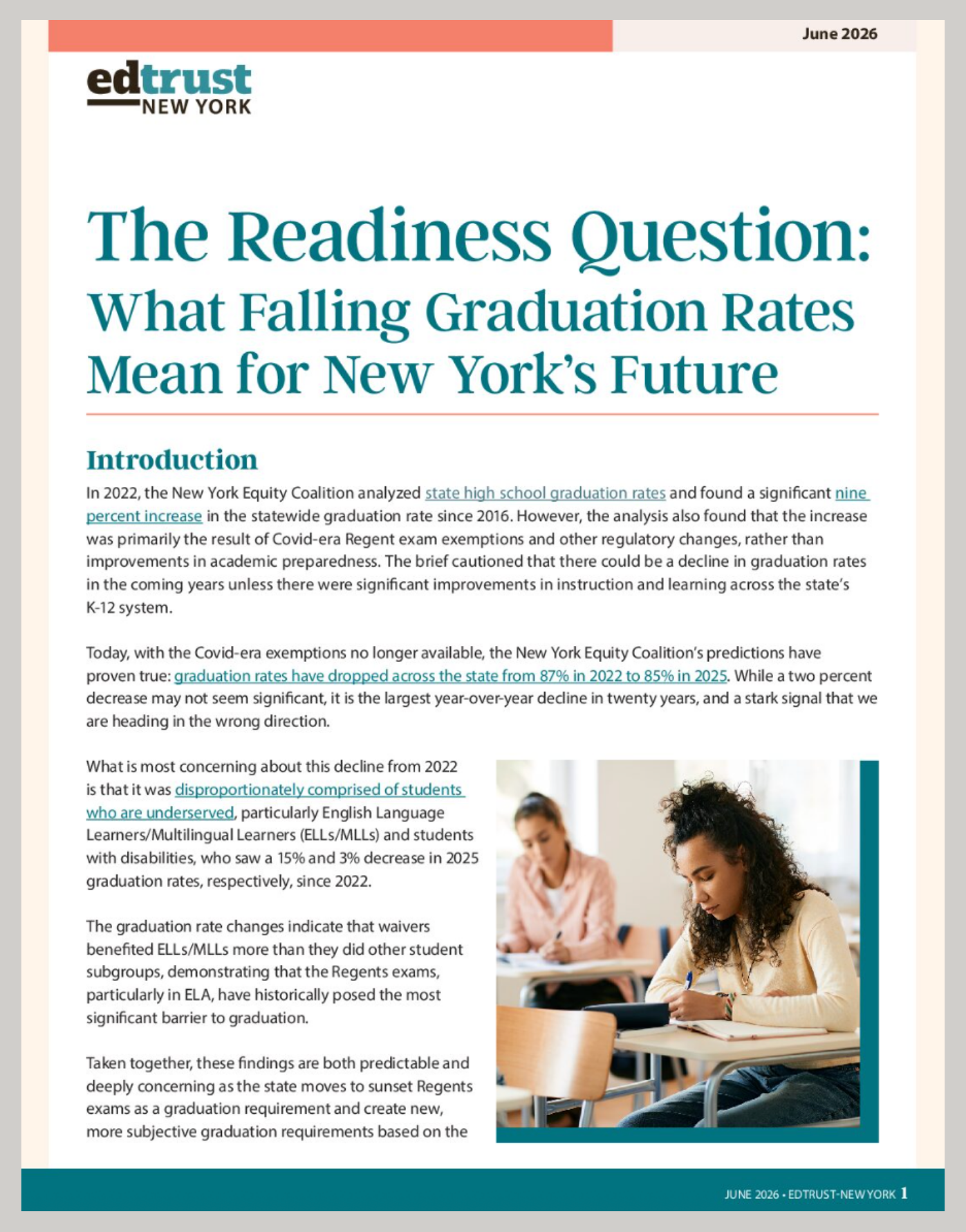
The Readiness Question: What Falling Graduation Rates Mean for New York’s Future
This analysis finds that New York’s high school graduation rate declined from 87% in 2022 to 85% in 2025—the largest year-over-year drop in two decades. While graduation rates remain higher than pre-pandemic levels, the decline raises important questions about whether students are receiving the support and opportunities they need to succeed after high school. The findings also validate concerns raised by EdTrust-New York and the New York Equity Coalition in 2022, when graduation rates surged during the COVID-19 pandemic. At the time, advocates cautioned that Regents exam exemptions and other temporary policy changes were driving much of the increase, rather than substantial improvements in student learning and college and career readiness.
Featured Reports and Resources Over the Years

Statement: Graduation Data for the Class of 2023

Brief: What’s Behind the State’s Improved Graduation Rates?

Statement: Changing High School Graduation Requirements

Opinion: How New York’s Bid to Reduce Graduation Requirements Could Backfire
Data Snapshot
%
The share of students earning a Regents diploma dropped from 51% in 2022 to 49% in 2025, while more students earned local diplomas.
%
New York’s graduation rate fell from 87% in 2022 to 85%.
More Resources
EdTrust-New York Responds to NY Gov. Kathy Hochul’s 2025 State of the State Address
EdTrust-New York calls for stronger commitments to educational equity and looks forward to collaborating with the Governor and Legislature to ensure the inclusion of the following proposals in the final 2025 State Budget.
Bridging the Gap: Ensuring True College and Career Readiness for All Students
As the Board of Regents considers changes to graduation requirements, we must avoid creating a system that perpetuates rather than dismantles inequities.
EdTrust-New York Statement on Changing High School Graduation Requirements
While we support the New York State Education Department’s (NYSED) move to expand diploma pathways for students, our primary concern is that the proposed changes to graduation requirements will lead to varying standards of rigor across districts.
EdTrust-New York statement on graduation data for the class of 2023
The data released by NYSED lacks transparency in terms of how many students graduated with exemptions or other changes made to the graduation requirements during the pandemic.
Arlen Benjamin-Gomez named executive director of EdTrust-New York
Prior to joining Ed Trust–NY, Arlen worked as an education equity advocate and policymaker for more than 20 years, deeply rooted in the fabric of New York. She recently served as an education equity advisor and consultant, collaborating closely with states, districts, and nonprofit organizations to propel racial, socioeconomic, and cultural equity in education.
EdTrust-New York statement on the Blue Ribbon Commission on Graduation Measures Recommendations
The Blue Ribbon Commission’s recommendations on graduation measures reflect the diversity of the group as well as the commission’s deep commitment to the success of all children.