School Climate
As students continue to recover from the pandemic, mental health and social-emotional support are critical. We also need inclusive school cultures that prioritize recruiting and retaining educators and school staff of color, which is essential to meeting the needs of New York State’s diverse student population.
As schools continue to recover from the pandemic, mental health and social-emotional support and inclusive school cultures that prioritize recruiting and retaining educators, school leaders, and counselors of color are essential to meeting the needs of New York State’s diverse student population.
Our Equity-Centered Approach
We support policies that increase the number of counselors, educators and school leaders of color in school buildings, provide mental and health services in schools, holistically address chronic absenteeism, implement restorative justice practices, and other positive alternatives that keep students in the classroom. Such policies mitigate disruption in learning and dismantle barriers that prohibit children from attending school and feeling welcomed once there.
Latest Resource
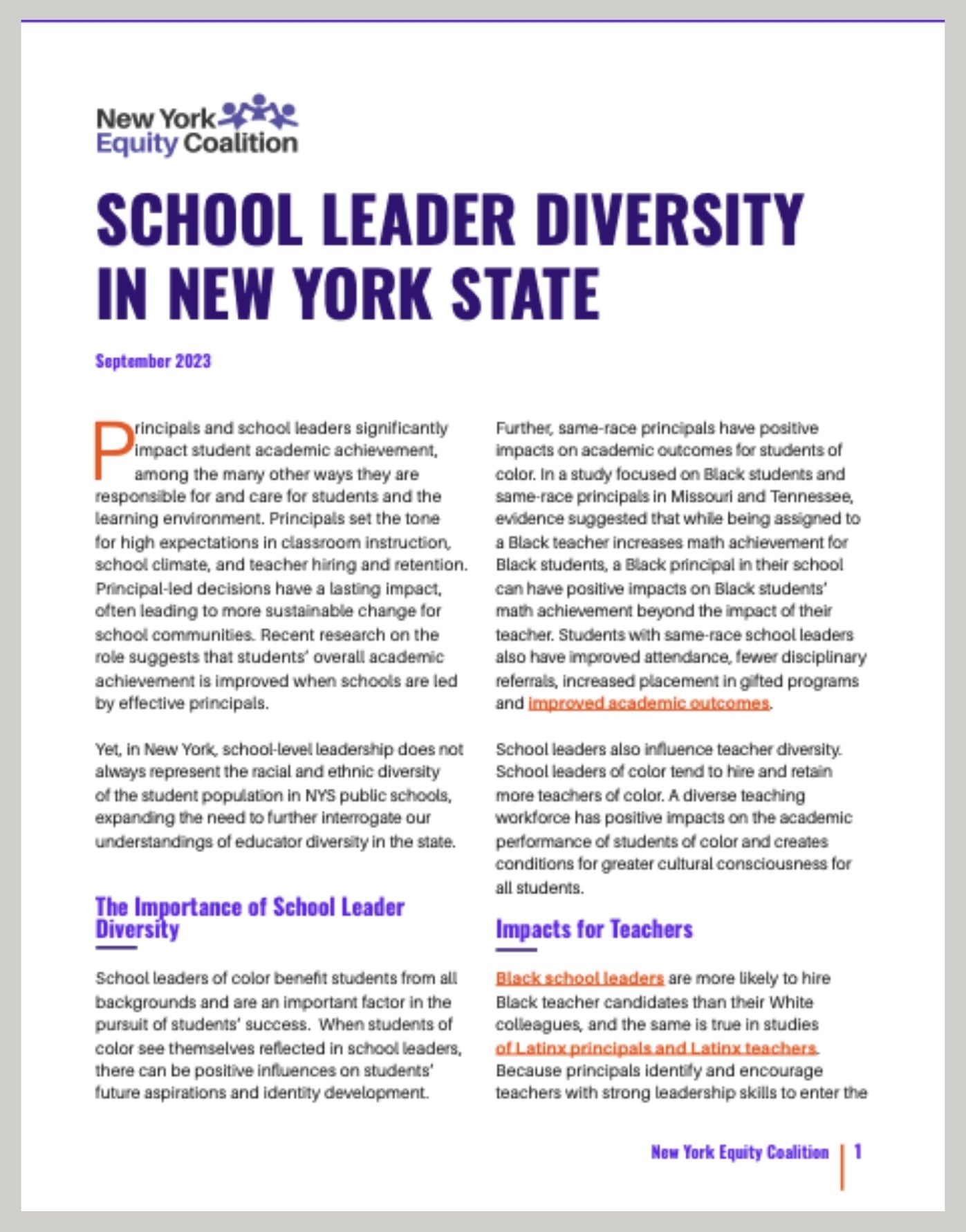
Report: School Leader Diversity in New York State
School leader diversity benefits students from all backgrounds and is an important factor affecting students’ success in schools. Attending a school with a principal of color has positive impacts on academic outcomes for students of color. Yet school leader diversity statewide reveals that more than half of students attend schools without any leader of color.
Featured Reports and Resources Over the Years
Blog: In NYCPS, Brown v. Board remains…unfulfilled
Statement: EdTrust-New York Denounces New Policy on Immigration Arrests in Schools

Report: New York State’s Suspension Crisis

Blog: 5 Things to Know About the Influx of Migrant Students in New York
Data Snapshot
Only
of young adults in New York State said they had access to mental health supports in high school.
In the 2022-23 school year, nearly half of Black (46.4%) and Latinx (43.7%) students were chronically absent, compared to just 24.7% of White students.
More Resources
EdTrust-New York Responds to NY Gov. Kathy Hochul’s 2025 State of the State Address
EdTrust-New York calls for stronger commitments to educational equity and looks forward to collaborating with the Governor and Legislature to ensure the inclusion of the following proposals in the final 2025 State Budget.
In New York City Public Schools, Brown v. Board remains…unfulfilled
This year, May 17th marks the 70th anniversary of Brown v. Board of Education, the U.S. Supreme Court decision that banned segregation in public schools, stating that separating children based on race was unconstitutional. And here in New York City, one of the most diverse cities in the world, that goal remains unfulfilled. School segregation continues to be the worst in the nation.
Arlen Benjamin-Gomez named executive director of EdTrust-New York
Prior to joining Ed Trust–NY, Arlen worked as an education equity advocate and policymaker for more than 20 years, deeply rooted in the fabric of New York. She recently served as an education equity advisor and consultant, collaborating closely with states, districts, and nonprofit organizations to propel racial, socioeconomic, and cultural equity in education.
Celebrating Progress on Educator Diversity in New York
This report on educator diversity draws lessons from how the New York State Education Department (NYSED), local school districts, institutions of higher education, schools, and advocates are working toward improving educator diversity and retaining teachers of color.
A look at New York State public school enrollment trends in 2022-23
Public schools in New York state have seen enrollment decline for the better part of the last decade. Data from the 2022-2023 school year, however, shows that the declines have finally begun to slow.
EdTrust-New York Statement on NY Gov. Kathy Hochul’s 2024 State of the State Address
Governor Hochul’s 2024 State of the State proposal includes several important proposals that will advance educational equity for New York children, students, and their families.