College Credit in High School
College in high school programs — programs that allow students to earn college credit through taking college courses offered in partnership between institutions of higher education and high schools — introduce postsecondary options to students early. When students have access to college courses in high school, they are more likely to persist in college and earn a degree. Yet too few students have access to these programs, particularly students of color — especially Black, Latinx, and Native American students, and those from low-income backgrounds.
Our Equity-Centered Approach
We work alongside our partners from the New York Equity Coalition to champion policies that provide equitable access to college credit in high school. We advocate at the state and district level to ensure programs center equity and are accountable to both student performance and postsecondary success. That starts with removing barriers to access for students of color and from low-income backgrounds while increasing data transparency about the access to and outcomes of college credit in high school programs — also known as early college and dual enrollment programs.
Latest Resource
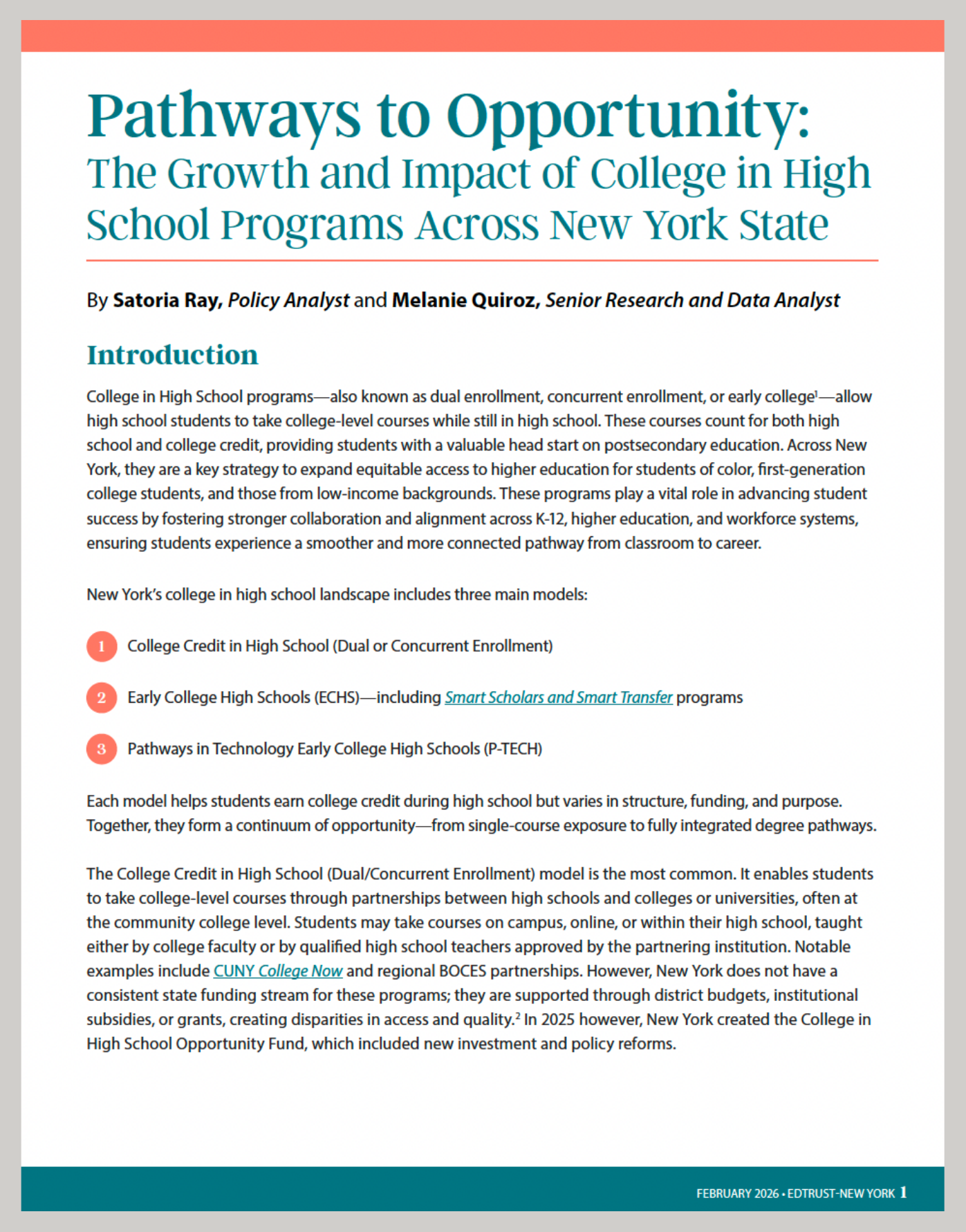
Pathways to Opportunity: The Growth and Impact of College in High School Programs Across New York State
This brief highlights significant growth in college in high school participation and strong graduation outcomes for students across the state, particularly for students of color, students from low-income backgrounds, multilingual learners, and students with disabilities. The analysis examines enrollment and graduation data from the 2020-2021 through 2023-2024 school years across three primary College in High School models recognized by the New York State Education Department: P-TECH, Smart Scholars, and Smart Transfer programs.
Data Snapshot
Only
%
of young people in New York City report having access to dual enrollment courses.
In New York
%
of students from low-income backgrounds who took early college courses in high school graduated college in four years, compared to only 23% of their peers.
More Resources
Testimony: 2023 Joint Legislative Budget Hearing — Elementary and Secondary Education
As the budget season progresses, we presented before the New York State Senate and Assembly 2023 Joint Legislative Budget Hearing regarding elementary and secondary education priorities.
State of the State 2023 Priorities
A critical moment: Governor Hochul’s State of the State presents ideas and opportunities to advance educational equity
EdTrust-New York statements on 2022 State of the State proposals
The following can be attributed to Dia Bryant, executive director of EdTrust-New York: “Governor Hochul’s State of the State agenda includes several promising proposals to advance educational equity in New York State from birth through college and into the workforce....
Dual enrollment programs allow Yonkers Public Schools graduates to get a taste of college
Students in the Yonkers Public Schools have an opportunity to take college-level classes through a number of different programs that aim to better prepare them for the more rigorous courses they will encounter in college. Since Superintendent Dr. Edwin M. Quezada took...
EdTrust-New York comments on State of the State agenda and Executive Budget
Improving access to critical courses, reducing suspensions, and improving teacher diversity among the promising proposals The following can be attributed to Ian Rosenblum, Executive Director of EdTrust-New York: “Governor Cuomo’s State of the State agenda and...
EdTrust-New York submits public comment on New York’s ESSA regulations
August 15, 2018 Dr. Lisa Long New York State Education Department Office of Accountability, Room 400 55 Hanson Place Brooklyn, NY 11217 Via E-Mail: [email protected] Dear Dr. Long: We share the New York State Education Department (NYSED) and...