English Language Learners/Multilingual Learners
Multilingual learners make up a growing and increasingly diverse share of New York’s student population—12% statewide in 2025—including many newcomer and migrant students with unique needs and interrupted schooling, as well as students in rural and suburban communities that have not historically served them.
Yet these students continue to face significant barriers to accessing high-quality instruction and supports: too many are steered away from high school into GED or adult English as a New Language (ENL) programs, and there are not enough bilingual, ENL, or summer learning opportunities to meet demand. Long-standing inequities and structural factors — worsened by the pandemic — including under-resourced schools, limited access to certified teachers, and segregation, continue to shape their educational experiences and outcomes.

Our Equity-Centered Approach
We work to strengthen advocacy efforts that expand educational opportunities for ELLs/MLLs across New York State, especially at a time of increasing need. As more migrant and newcomer students arrive, shifting federal policies — including threats to immigration status and cuts to instructional supports — are compounding long-standing challenges for students and schools. These challenges underscore the urgent need for policies and supports that ensure all students can safely access and fully participate in their education and receive the supports they need to succeed.
Latest Resource
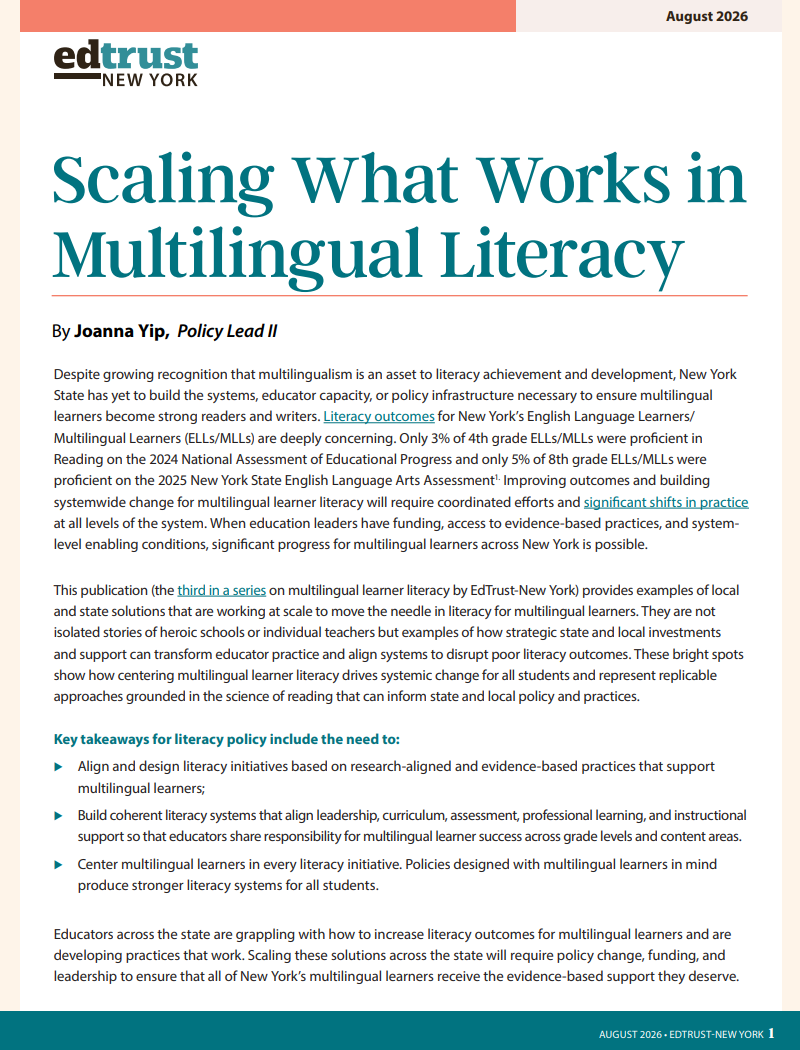
Scaling What Works in Multilingual Literacy
Reading on the 2024 National Assessment of Educational Progress and only 5% of 8th grade ELLs/MLLs were proficient on the 2025 New York State English Language Arts Assessment1. Improving outcomes and building systemwide change for multilingual learner literacy will require coordinated efforts and significant shifts in practice
at all levels of the system. When education leaders have funding, access to evidence-based practices, and system-level enabling conditions, significant progress for multilingual learners across New York is possible
Featured Reports and Resources Over the Years

Statement: EdTrust-New York Backs Gov. Hochul’s Efforts to Defend Education Access for All

Statement: EdTrust-New York Criticizes State Budget’s Foundation Aid Changes

Blog: Reflections from the Leading Literacy Summit

Statement: Proposed ELL Funding Changes Would Deepen Inequity
Report: Out of Reach — The State of Multilingual Learner Literacy in New York
Report: By the Numbers — Multilingual Learner Literacy Outcomes in New York
Data Snapshot
Only
%
of ELLs/MLLs in grades 3-8 scored proficient on the 2024-25 English Language Arts assessment, compared to 58% of their monolingual English-speaking peers.
*New York State Assessment Results, 2024-25
Only
%
of ELLs/MLLs graduated on time in 2025, as opposed to 88% of non-ELLs.
*New York State Graduation Rates, 2024-25
More Resources
EdTrust-New York Highlights Proven Strategies to Improve Literacy Outcomes for Multilingual Learners Across New York
EdTrust-New York today released “Scaling What Works in Multilingual Literacy,” a new report that highlights proven strategies to improve literacy outcomes for multilingual learners and calls on New York policymakers to scale evidence-based practices that help more students become confident readers and writers.
Scaling What Works in Multilingual Literacy
Despite growing recognition that multilingualism is an asset to literacy achievement and development, New York State has yet to build the systems, educator capacity, or policy infrastructure necessary to ensure multilingual learners become strong readers and writers. This publication provides examples of local and state solutions that are working at scale to move the needle in literacy for multilingual learners. These bright spots show how centering multilingual learner literacy drives systemic change for all students and represent replicable approaches grounded in the science of reading that can inform state and local policy and practices.
The Readiness Question: What Falling Graduation Rates Mean for New York’s Future
This report shows that New York’s high school graduation rate fell from 87% in 2022 to 85% in 2025. That two-point drop marks the largest year-over-year decline in two decades and reveals persistent inequities in educational opportunities and outcomes.
Out of Reach: The State of Multilingual Learner Literacy in New York
This report finds that the state’s recent literacy reforms fail to meaningfully include multilingual learners, despite their share of the student population and persistently low literacy outcomes.
By the Numbers: Multilingual Learner Literacy Outcomes in New York
This report (one in a series by EdTrust-New York) examines trends in multilingual learner literacy performance in English and home language measures to identify where students need stronger support.
Testimony for New York City Council – Fiscal Year 27 Preliminary Budget – Education
As the largest district in the state and nation, serving nearly 1 million students, New York City Public Schools (NYCPS) is a key focus of EdTrust-New York’s commitment to advancing equity-focused educational efforts across the state. Such investments are even more critical this year due to federal funding cuts and attacks on critical educational equity programs.